There’s been a lot of hemming and hawing about the recent dietary guidelines. I have to say, I had to do a double take when I saw that they lived on realfood dot gov. What in the Twilight Zone is this?
I immediately saw the online praise as well as backlash. Everyone had an opinion on them, and it seemed their opinions were formed quite quickly and mostly based on the 10-page document designed for the general public, including their new inverted food pyramid. The reason I haven’t publicly commented on these until now is that I needed to read through the totality of the guidelines.
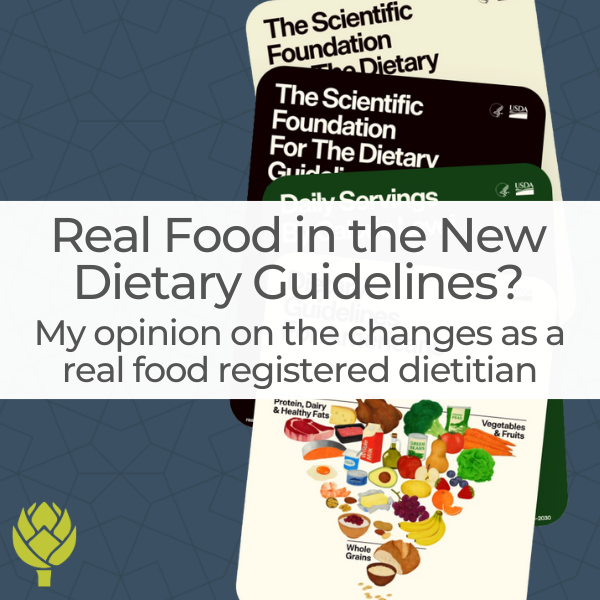
They are split into 4 documents in total, the 10-pager mentioned above and the remaining documents being 1) the daily servings by calorie level, and 2 and 3) two other documents that go through the research supporting these recommendations, totaling over 500 pages of scientific review. Those other two documents are available here: 90-page scientific foundation and the 418-page appendices, which has a series of narrative reviews on various nutrition topics, like processed foods, refined carbohydrates, protein, vegetarian diets, etc.
Real Food in the New Dietary Guidelines? My Opinion on the Changes as a Dietitian
Some parts of the guidelines are pretty much unchanged.
- Total recommendations on servings of fruits and vegetables are almost identical (slight increase in vegetable servings by an extra half cup a day).
- Total servings of dairy remain (3 servings daily, although type of dairy recommended has shifted, see below).
- Encouragement to consume whole grains has not changed (more nuance on this below).
- The guidelines have always discouraged added sugar and excess alcohol consumption, and this remains true in the new guidelines (though they tightened up the language on added sugar, especially for children).
In the remainder of this article, I’ll cover what I like about the new guidelines and what I don’t. This is more detailed than I had anticipated, so bear with me.
What the 2025 Dietary Guidelines Get Right
Now there’s some noteworthy improvements, so I’ll point those out first:
- There’s a substantial focus on eating real, nutrient-dense foods. And unlike past guidelines, which used the term “nutrient-dense” incorrectly (like stating that sparkling water was nutrient-dense relative to soda and vegetable oil as nutrient-dense compared to butter — I’m not making this up, see figure 1–2 titled “Making Nutrient-Dense Choices”), these new guidelines accurately represent nutrient-dense foods as those which are unprocessed and rich in micronutrients.
- The order in which food groups are introduced is different from prior guidelines. Even if the same food groups are included overall, the new guidelines lead with protein-rich foods, dairy, vegetables, fruit, healthy fats, and then whole grains. The 2020 guidelines lead with vegetables, fruit, grains, protein foods, and oils (see page ix).
- Protein recommendations increased dramatically. Past guidelines recommended 0.8 g/kg of protein. The new guidelines recommend 1.2-1.6 g/kg. This is right in line with the data, and aligns with the recommendations I give in my books. This is a win! When people have asked me how I’d reform guidelines, the #1 change I have suggested is increasing protein. I’m thrilled to see this.
- Healthy fats are defined differently. In the new guidelines, they state “Healthy fats are plentiful in many whole foods, such as meats, poultry, eggs, omega-3–rich seafood, nuts, seeds, full-fat dairy, olives, and avocados. When cooking with or adding fats to meals, prioritize oils with essential fatty acids, such as olive oil. Other options can include butter or beef tallow.” Whereas the 2020 guidelines specify healthy fats as “vegetable oils and oils in food, such as seafood and nuts.”
- Side note: The 418-page document covering the scientific foundation for the dietary guidelines is worth a read. I was pleasantly surprised to see a whole section on the issues with oxidized oils (entitled “Effects of Thermally Stressed Added Fats on Cardiometabolic Health” on page 318-345). This is a topic that has not been covered in prior guidelines; rather past guidelines explicitly encouraged the consumption of vegetable oils. Here, they call out the harms of these oils, particularly when they’re used for cooking or frying.
- Red meat, animal foods, and full-fat dairy are no longer vilified. Past guidelines encouraged only lean meat, and low-fat and non-fat dairy products; they also specifically discourage red meat consumption. These new guidelines state: “Consume a variety of protein foods from animal sources, including eggs, poultry, seafood, and red meat, as well as a variety of plant-sourced protein foods, including beans, peas, lentils, legumes, nuts, seeds, and soy.” These new guidelines also encourage full-fat dairy products. (Be sure to read my criticisms of the saturated fat recommendations below though!)
- Refined grains are no longer recommended whatsoever. Past guidelines specify “half your grains whole” and even include recommended daily serving allotments for refined, enriched grains. For a 2,000 calorie diet, the 2020 guidelines recommended 6 servings of grains per day — 3 whole, and 3 refined. In the new guidelines, they kept intact the whole grain recommendations (for a 2,000 calorie diet, they recommend 2-4 servings of whole grains per day), but they specifically discourage consumption of any refined grain products. Overall, these guidelines are highly critical of refined grains and processed foods in general, noting that “No previous USDA Dietary Guidelines have addressed the impact of processed foods on population health.”
- The new guidelines highlight nutritional pitfalls of vegetarian diets, which is not something adequately covered in prior guidelines. In the section on vegetarian and vegan diets, they state: “Pay careful attention to potential nutrient gaps when consuming a vegetarian or vegan diet. Vegetarian diets often fall short in vitamins D and E, choline, and iron, whereas vegan diets show broader shortfalls in vitamins A, D, E, B6 , and B12; riboflavin; niacin; choline; calcium; iron; magnesium; phosphorus; potassium; zinc; and protein. Monitor nutrient status periodically, especially for iron, vitamin B12, vitamin D, calcium, and iodine. To avoid nutrient gaps, prioritize targeted supplementation, diversify plant protein sources for amino acid balance, and enhance mineral bioavailability through food preparation techniques.” There’s also a detailed section on the research behind these claims in the Scientific Foundation document, written by a researcher that I highly respect, Ty Beal, PhD. I’ve highlighted some of his work in past research briefs, like this 2022 one on nutrient-dense foods.
- Low carbohydrate diets finally get a little recognition. In the section for “Individuals with Chronic Disease” they state: “Individuals with certain chronic diseases may experience improved health outcomes when following a lower carbohydrate diet. Work with your health care professional to identify and adopt a diet that is appropriate for you and your health condition.” This is definitely a first as past guidelines always harped on specific percentage of the diet coming from carbohydrates. Here, personalization is encouraged (and there’s lots of studies cited on this in the appendices, see the sections written by Jeff Volek, PhD as well as the sections by Ben Bikman, PhD).
Issues and Inconsistencies in the New Dietary Guidelines
Despite some improvements, I noted the following issues with the new guidelines:
- Their website depicts the new inverted pyramid as a replacement for the 1992 pyramid, but doesn’t acknowledge that the old pyramid hasn’t been used since 2011, when MyPlate was introduced. I personally find some version of the Plate Method more user-friendly than the hierarchy of a pyramid (hence why I include my own version of a plate within all my books!). I think it communicates macronutrient balance at meals better and also more clearly shows relative portion sizes. I have other qualms with this visual, but I’ll leave it at that for brevity.
- The Daily Servings by Calorie Level document has some errors and inconsistencies. For some reason, their protein food category has example serving sizes that do NOT provide an equivalent amount of protein. All prior guidelines have used protein servings consistent with a protein content of about 7g per serving. These new guidelines list meat as a 3 oz serving, but 1 egg is also considered a serving). If you follow their recommendation of 3-4 daily servings of protein for a 2,000 calorie diet, you could be choosing 9 oz of meat/fish (~63g protein) or 3 eggs (~21g protein). I know this sounds nit picky, but these policies have to translate into the food service side for programs like Head Start, hospital meals, school lunches, etc. They really needed to bring in a dietitian to ensure these recommendations were appropriately translated onto the daily servings document. For what it’s worth, I could not locate a single dietitian among the scientific review authors. I saw some chatter on X/Twitter from some of the DGA committee members indicating that they are working with HHS to get the daily servings document updated.

-
- Of note, in Appendix 4.9. “High-Quality, Nutrient-Dense Protein Foods” on pages 346-389, there’s a table on page 381 clarifying their protein food serving sizes. This table should have been included in the public-facing materials or have been properly translated into the Daily Servings by Calorie Level document, but it wasn’t. I like this table, as it specifies different types of protein foods, including recommendations on seafood, legumes, nuts/seeds, etc. And no, despite many criticisms stating otherwise, these new guidelines do not exclusively recommend red meat. The one thing I dislike about this table is that they only recommend 3 or more eggs per week; I think it should be more to assure adequate choline intake.

-
- One of my readers, nutritionist Deena Thompson, pointed out another inconsistency in the new guideline’s protein recommendations. She writes “The DRI Calculator that’s linked on their Daily Servings Calculator to calculate your individual nutrient needs, it’s still stuck on the old model for protein (0.8g/kg) and giving advice that is completely contradictory to what’s stated in the document.”
- Another issue with their Daily Servings by Calorie table is the fat servings. When comparing the 2,000 calorie diet tables from both the 2020 and the new 2025 guidelines, I noted that the total fat servings actually decreased. Yes, they lowered them from 6 teaspoons per day to 4.5 teaspoons per day. Is this because more fat will now be consumed from whole food sources (like meat and dairy)? Or is this an error, much like the protein servings above (lack of RD oversight)? That’s not clear to me.
- They choose to maintain a cap on saturated fat at no more than 10% of calories, right in line with past guidelines. The evidence base for this recommendation is weak, at best, especially considering the saturated fat sources they recommend are coming from whole foods. It is also nearly impossible to follow their food recommendations and simultaneously stay below 10% of calories from saturated fat. When I say “nearly impossible”, I mean it. You’d have to choose exclusively reduced fat dairy products, lean meat, and have almost no added fats to meet this recommendation, yet the guidelines are telling you to enjoy full-fat dairy, to embrace red meat, and even to cook with butter and tallow. Out of curiosity, I ran some of my own meal plans through a full micronutrient analysis (yes, the old fashioned way, because using AI for this does not reliably work, friends). Consistently, saturated fat came out to an average of 15-20% of calories. It remains to be seen whether federally-funded programs that are required to follow these guidelines will prioritize the food recommendations or the saturated fat cap. We’ll see.
- They maintain the same outdated sodium guidelines as before (<2,300 mg/day). They did, however, soften their language around salt, stating “Highly active individuals may benefit from increased sodium intake to offset sweat losses. Highly processed foods that are high in sodium should be avoided.” Past guidelines have almost exclusively focused on the supposed “harms” of sodium.
- They didn’t include sample meal plans showing the guidelines as actual meals. I think the general public would benefit from seeing real world examples. It also would have highlighted the inconsistencies between the guidelines and the arbitrary cap on dietary saturated fat.
- They didn’t go into as many specifics on nutrient needs by life stage, which is something the 2020 guidelines did. While I disagree with many of the recommendations in the 2020 guidelines, I do think there’s value in covering the life stages more specifically. There are some brief sections in the 2025 guidelines on pregnancy and lactation (they’re accurate, from what I saw), but they’re not very detailed. Nothing like the level of detail you get from Real Food for Pregnancy.
Lest this turn into a veritable thesis paper, I’m going to leave it at that.
Having worked at the public policy level in a very small subset of dietary guidelines (specifically, the California Diabetes and Pregnancy Program guidelines), I want to acknowledge that no guidelines are perfect. It also takes an immense amount of time, patience, and collaboration to come to any sort of consensus, and even then, there will be people on the team that disagree. Believe me, I was working in that role when our team was tasked with moving from the pyramid to the plate and some of the dietitians in the group were really really attached to that pyramid!
But I digress.
All politics and other policies aside, I think these guidelines are a step in the right direction. They need some refinement, for sure. But if this means that school lunches, Head Start meals, food for our troops, hospital food, meals served in nursing homes, food at daycares, etc. now start offering more whole food, protein, whole fat dairy foods, butter instead of margarine, and less refined grains and processed foods, that is a win. These changes may also ultimately impact which foods are included in WIC, which could be a huge win. I’ve been invited to speak by numerous state WIC agencies and many of the staff have expressed the need for more coverage of protein-rich foods. If these guidelines help accomplish that, that would be amazing for mothers and families.
Most Americans don’t follow these guidelines (what’s new?), but programs that accept federal money have no choice. This is why the guidelines matter so much.
Until next time,
Lily
PS — I’d love to hear your thoughts on the new guidelines. What areas improved? What areas didn’t?